Managed Care

I grew up in a family that was doctor-averse. 

They weren’t anti-vax, anti-science, ideological weirdos. But it was complicated.

Depression-era frugality led to most of  my parents’  “I’ve seen worse” responses to childhood lacerations and stomach viruses experienced by me and my three siblings. But my parents’ aversion to paying for medical treatment also was colored by my father’s DVM degree: My father’s license to treat mammals extended to his children. The fact that we all reached maturity is a testament not just to the public health advances that gave us school vaccinations and fluoride in our toothpaste. Surviving to the age of legal voting was due to the gallon jar of veterinary-grade tetracycline on the kitchen counter and the fact that antibiotic resistance hadn’t yet been invented. Childhood accidents received the same DIY treatment. My youngest brother, fading back to catch a football, once sliced open his head on an electrical box. My father mended that gash on our kitchen table, with my brother stoically trading local anesthesia for efficiency. 

My family, of hardy pioneer stock, accepted that children living on a farm would bash or slice themselves open with some regularity, and that the gaping wounds would usually heal themselves, perhaps with help from a needle plucked from the autoclave in my dad’s clinic. When I was in high school, I belatedly noticed a gash hidden below my ankle joint, received when a rusty barn door blew open. By the time I paid it any attention, it was making rather a spectacle of itself. I couldn’t get a good look at it, but it must have been unappealing, because my mother drove me to the local osteopath for stitches. For the only time in our lives. Sincere Dr. Fast tried to make sense of the mangled, half-healed tissue presented to him. As he ripped up the scabbed-over bits with a scalpel to put in fresh sutures, Dr. Fast queried my mother, “Has she been away at school?” No, returned my mother mildly. “Has she been on a trip?” Ah, now she saw where this was going. No, she said firmly. “She’s eaten three meals a day at my table.” The entire family has been living with that god-awful, vultures-are-circling, “Snows of Kilimanjaro” piece of weeping flesh for most of a week. Your point?

My family’s cost-effective system worked fabulously, even for me and my unfortunate ankle, until it met a virus rarely discussed by people living in countries with plumbing and air conditioning and credit cards. The Mayo Clinic recommends, “Make sure your own vaccinations are current.” Trust the Minnesota folks on this one, friends, or you’ll be part of your state’s epidemiological statistics, and not in the good way. As evidence, I submit the following tale.

Before I started my sophomore year of college, my cousin Candy took me for an outing to fancy Quail Springs Mall in Edmond, the white-people Oklahoma City suburb. Outings with Candy, the shopping savant, can be exhausting even for those in fighting trim. This time, however, I wasn’t just tired. My throat hurt in a way I didn’t know throats could hurt. Consequently, my requests escalated from, “Can we leave in half an hour?” to “How about we pull into that emergency room in Kingfisher and visit my brother the pharmacist?”

There’s no waiting in line in Kingfisher Memorial Hospital, and you get service from the same doctor who attended your delivery. The very doctor who knows all about the family tetracycline treatments and has warned my parents, “When they start barking, don’t bring them to me.” Dr. McIntyre swabbed my throat, prescribed antibiotics, and pledged to call when the culture came back. 

Now begins the part of this anti-doctor story belonging to my mother. She and my father both had a less-is-more approach to health care, but my mother’s relationship to medicine was, well, complicated. Her response to my health predicament started with doctor shaming. My mother was incensed that I had walked into an emergency room, her point being that if you are walking, by definition you are not an emergency. Despite my profligacy, I was a miserable study in infectious diseases until the antibiotics kicked in. Life was fine until the prescription ran out while I was at sorority rush and that sore throat returned. The university was all about avoiding liability, so some responsible adult took me to the campus infirmary. I was functional again.  

But where were those lab results? When I drove back to Kingfisher to get the rest of the story, Dr. McIntyre explained why the results had taken longer than expected. He had sent my sample to the state lab for a do-over, because he didn’t believe that I actually had (wait for it) diphtheria. Which I did. Which meant that I got upgraded to diphtheria-level antibiotics. Believe the science. God wants you to take these meds.

Couple of things will be happening pretty quickly about now. I call my cousin Candy to tell her what I’ve exposed her to. She and her mother will be simultaneously horrified (“You slept in the same bed!”) and compassionate (“She must have outgrown her immunization. Or something.”) No one would have presumed that my parents would have raised an unvaccinated child, so no one said out loud the most likely explanation of my condition. It takes five DTaP shots for children to achieve full protection against diphtheria. I probably hadn’t been to the doctor five times in my entire life. Birth order is everything, and parents cut some corners for the fourth child.

When I walked up the steps of my mother’s house with my new prescription, my mother and I were both furious. She was predictably angry because I’d gone to the doctor, again, rather than reasonably take care of myself. This time, my self-righteous teenaged self returned fire with weapons-grade guilt. “Get my rest? Take care of myself?” Here, I’m ashamed that I inserted some versions of “Ha!” or “Oh yeah?” into this exchange. I was 19 years old and insufferable. Then I delivered the punchline: “I’ve got diphtheria!” Cruel as it seems now, I walked on and didn’t wait for her reaction. Because here’s what we both knew: At ages 8 and 9, my mother and her sister Iris contracted diphtheria, and her sister died. 

My virus-ridden teen-aged self opened a door to family psychodrama that had been shut since 1929. Other than a single photograph hanging in my grandmother’s front bedroom, Aunt Iris had disappeared into the ether. I never heard my grandmother speak of her. Iris and my mother were Irish twins; she was my mother’s constant companion. Yet my mother was the girl that lived, and she and my grandmother seemed silently to agree that some mistake had been made. Best not to speak of it. In this environment of omerta, it took me ages to discover the origins of the nickname I heard my mother called at my grandmother’s house. As a child, I couldn’t fathom why my mother’s own family couldn’t pronounce her name correctly–”Kathleen.” Instead, they called her the name as Iris pronounced it when my mother was a baby: “Kappy-tu,” shortened to “Kappy.” Each time her parents or four younger brothers said my mother’s name, Iris’s word was in their mouths. 

Hennessey Clipper, April 25, 1929

As a bored child, I once sat at the kitchen table doing some summer activity while my mother washed dishes, her back to me, as we chatted about her childhood home. Her father loved her mother so much he built her a new house when none of the other farmers were taking care of their wives so well. Her house had an electric generator in its basement, very fancy. “Did you have a cistern?” I asked. Our farmhouse has one, and I thought every well-appointed home should have such an ingenious rainwater collection system. Oddly, my mother didn’t answer. I thought she didn’t hear me, so I repeated my question. “Did you have a cistern?” Now I turned to look at her unmoving back. She didn’t look at me, and I must have asked again, prompting her to finally say, without turning around, “Yes, but she died when she was very young.” “Oh no, I said cistern, for your water!” But that conversation was over, and would, it appeared, stay closed indefinitely. After I contracted diphtheria, I finished my course of antibiotics with no comparisons made to that earlier, deadlier outbreak in the fancy house with the electric generator.

I had just one other conversation with my mother about diphtheria, but it cast my childhood’s lack of doctors in an entirely different light. During a long layover in the Atlanta airport, I had my mother to myself, with very few distractions. In her own home or mine, she would have been cleaning, folding, cooking. But in that time before cell phones, all we could do was talk. She told me about living on the Army base in New Jersey, and her friends in the Women’s Army Corps. She described the days when my brothers and I were born. And she told me about her sister.

A family in her country neighborhood was sick, so my grandmother carried them food. My mother and her sister stayed at the gate of the family’s yard while her mother delivered the basket to their door. Some time after this visit, the girls became sick. The doctor came to the house and looked down their throats, covered with the leathery patches that diphtheria creates. Patches can grow large enough to restrict breathing, so a doctor would want to remove them. Iris later developed something like pneumonia. When her parents took Iris to the hospital, my mother’s Grandmother O’Hern came to stay with the remaining sick child, telling my mother that doctors would make her sister better. My mother, eight years old, told her grandmother, “No. She’s not coming back.”

When my Uncle Gayle came to my mother’s funeral, I told him the food delivery story. His response was “Jesus Christ.” Gayle seemed to confirm my suspicions about the origin of my mother’s conflict with her own mother. Try as she might, my mother was only ever going to look like an accusation. She was the presence that pointed to her sister’s absence. No one would have been cruel enough to blame my grandmother Nora Cain for the death of her child, but they wouldn’t have needed to: She was already there.

My mother’s most revealing detail in the Atlanta airport arose from stories about her World War II military service at Fort Dix. I got a funny story about a New York City plastic surgeon who offered to reshape her robust Irish nose to her heart’s desire. A free nose! But she declined; it was her father’s nose, too, and she wanted to keep it. In discussing Army health care, she mentioned the vaccinations she got when she arrived. But wait, I interrupted. Didn’t you already have those? Didn’t doctors come to your school to vaccinate students? Yes, they did, my mother agreed. But she waited in the bathroom until the doctors were gone. 

If I had taken a bite from my airport Cinnabon, I would have missed this new information. Apparently doctors terrified my mother so much that she hid in bathrooms to avoid them. In this context, my family’s avoidance of medicine wasn’t just about frugality, although, sure, we were cheap. It was about trauma. Doctors scrape little girls’ throats with scalpels to help them breathe. And when they come to your house, your sister dies. Why would you want any of that?  

As a child, I thought my parents embraced the same anti-medicine stance. On reflection, I see that my father had a triage system going, sorting out what conditions needed immediate attention and what could wait. My oldest brother got his tonsils removed; my youngest got attention before his appendix burst. My father spent a week in the hospital while various doctors figured out his prostate issues. My mother, however, lost her trust in doctors when she was eight years old, and she never got it back. Consequently, doctors were not her first call when she experienced the onset of a sudden inexplicable, debilitating neck pain. She put herself to bed and stayed there until a family friend finally drove her to a small regional hospital, where rural healthcare failed her a final time. Women’s heart attacks don’t look like men’s heart attacks. So the hospital sent her home, where she died the next day.
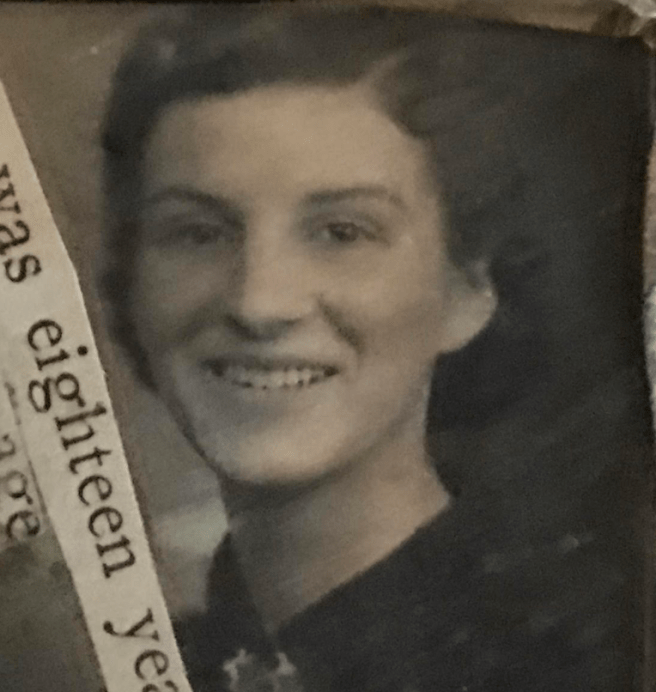
Kathleen Cain, 1938

During that layover in the Atlanta airport, my mother revealed the fear around which she had organized her life: Doctors can cause us the greatest pain because we encounter them when we are most vulnerable. At the age when my own children were managing strep throat with tasty pink Amoxicillin and popsicle therapy, my mother was facing down the loss of her sister, her survivor’s guilt, and a growing awareness that her own mother’s grief would make her life more complicated. My mother could have adopted any number of self-destructive coping strategies at this point; of the choices available to her, blaming her doctors seems like an absolutely genius solution. My mother never overcame that fear, but she tamped it down hard. And she compensated for her fear with a courageous, demanding ferocity that looked like love. Because it was.
Angry Weather

February 16, 2021, 32nd and Speedway streets, Austin, Texas

A year into a global pandemic, I’ve developed an anger management problem. 

It’s not my feral, uncut hair, or the strange substitutions that Randall’s makes in my grocery order. My god, half a million of my fellow citizens no longer have the luxury of caring about their hair and groceries.

It’s the weather, and when it becomes an “act of God.”

After Winter Storm Uri–we’re naming winter storms now?–I am constitutionally unable to speak rationally about power grids, the Texas Public Utility Commission, or Republicans who blame my 5-day power outage on wind turbines. During limited talk-to-other-people-time during Zoom calls or socially distanced pandemic chats, I lapse into rants that are the equivalent of TALKING IN ALL CAPS about my pure and sincere loathing of the Texas senator who flew to Cancun while our stoic Buff Orpington, Barred Rock, and Silver-Laced Wyandotte took refuge from freezing temps and laid eggs in our bathtub.

I’m from Oklahoma, so I know some weather. I’ve watched as the wind made a 20-foot barn door pitch like a ship at sea, sweeping my brother off his feet as he attempted to latch it down. I’ve hunkered in another brother’s storm cellar, heartily wishing I had picked up my baby’s diaper bag before dodging an inland hurricane. I’ve been frightened, humbled, and chastened by weather events, but incandescent rage hasn’t been my take-away, until now. 

Being enraged by the events surrounding Texas’ winter storm is not the way I was raised up. My family was of the play-dominoes-until-the-water-goes-down school of crisis management. But a central family narrative was built around a cataclysmic weather event, an act of god that was a source of awe and drama, the perfect pairing of climactic and climatic. I didn’t experience this event, but I’ve always known how it moved the people caught up in it, because they took the trouble to tell me. Time and again, relatives and countrymen would recall where they were in 1957 when the salty brown waters of the Cimarron River rolled up fences, unmoored bridges, and made the people of my county stop while rain and heartbreak said their piece. The drought of the South Plains broke in the spring of that year, perfectly timed to amplify the loss of my impossibly handsome 36-year-old uncle, inexplicably dead of a heart attack, with the sky weeping tears for his family.

Southern Methodist University Rotunda

The front page headlines of my hometown paper on May 16 juxtaposed the two events that subsequently reshaped Western Oklahoma generally and my family specifically. Above the fold: “Savage Rain and Hail Storm Hits Hennessey; Heavy Damage Seen.” Below the fold, the headline reads “Kelly Hobbs Dies in Midland, Texas.” For the heartbreak to properly resonate, know this about Dean Kelly Hobbs: he was the heart’s darling of his family. This was a family with no shortage of material to work with: my father, thoughtful, handsome, responsible. A lovely younger sister who rewarded her brothers’ antics with an astoundingly enormous laugh. But Kelly was their beating, bleeding heart, the beautiful child and gorgeous man who delighted and endeared just by drawing breath. 

Kelly died before I was born, but his lore persisted. I once spent an afternoon listening to a pal of Kelly’s named Beaman, who arrived unannounced at my mother’s table, then regaled me with stories about his friend, who by that time was 40 years dead. As an oil company landman in 1950s West Texas, Kelly would arrive in Midland regularly before weekends and file his paperwork with oil company secretaries. It was a mutually beneficial relationship. One Friday, he arrived with groceries at the house of a girlfriend, let himself in, and started supper. Several women shared this house, and they came home at the end of the workday. Multiple women entered the house, and apparently none of them were alarmed by the man in their kitchen. When the entire household was present, an awkward truth unfurled itself: the woman of Kelly’s acquaintance had moved to another house. By then dinner was ready, so they all sat down to eat.

Women made it their life’s ambition to marry my uncle. According to Beaman, Kelly’s boss watched a banker’s daughter focus on him with laser-like intensity. Addressing her persistence, the boss instructed Kelly to meet him in the oil company’s map room, where the glory of West Texas real estate was neatly marked with land owners’ names and pins for extant oil wells. Kelly’s boss pointed out the heiress’s extensive land holdings, and then observed, “I haven’t even shown you what her daddy owns.”

But like the hero of an F. Scott Fitzgerald novel, Kelly was not only charming and beautiful, he was also careless. In 1955, he married the executive secretary of a Denver oil man, and his life got complicated. He filed for divorce, but stress, and perhaps a blood clot from a minor car accident, left him dead on May 11, 1957.

Hennessey Clipper, May 16, 1957

The hometown weekly newspaper came out five days after Kelly’s death. The articles provide a timeline for the day’s events: 

  • 10 am funeral service at Methodist church
  • 1:30 pm -3:30 pm–a 2.31 inch rainfall
  • 3:30 pm-4:30 pm–rain stops
  • 4:30 pm-8 pm–8.74 more inches of rain

The day unfolded thusly: after the Methodist funeral, family and friends drove to the town cemetery, where they brought my uncle home, shoulder-high, under cloudy skies. Before 1:30, many family members drove to the Hobbs ranch house, on the Cimarron River, with Kelly’s parents. I’ve never gotten a definitive headcount of visitors, but the small 4-bedroom house appears to have been packed. By the time they got there, it had begun to rain. 

Hennessey Clipper, May 16, 1957

The crowd would have been crammed in the farmhouse from 1:30 to 3:30, during the first downpour. When the rain let up, some of the crowd said their goodbyes and headed back to town. The Briix cousins remember making it 3 miles, to the Firestone farm, where the road disappeared underwater. Teenaged Harvey Firestone was home alone and told them they couldn’t come in. The Briixes laughed and told him they couldn’t leave. Because by now had begun the Wagnerian deluge. The sky opened, and the rain farmers had awaited for seven years finally arrived. 

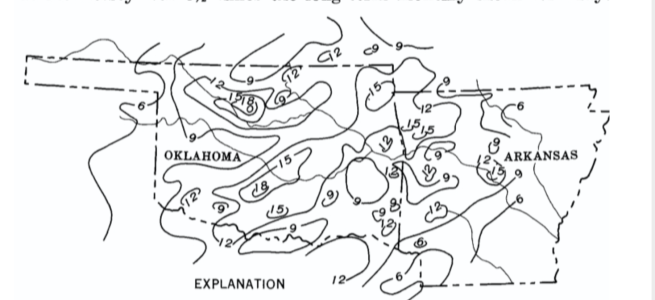
from “Floods of April-June 1957 in Oklahoma and Western Arkansas,” by D.L. and C.V. Sullivan, Prepared in cooperation with the States of Oklahoma and Arkansas, municipal corporations, and agencies of the Federal Government., https://pubs.usgs.gov/of/1957/0127/report.pdf

As reported by the U.S. Geological Survey:

The storm of May 15-16 occurred over an extensive area in western and Central Oklahoma, generally north of the Cimarron River. The largest amount of precipitation reported at a Weather Bureau station was 13.07 inches at Hennessey. The maximum amount of precipitation found in a “bucket” survey for the storm was 20 inches, 5 miles southwest of Hennessey, and occurred in the 11 hour period from 7 p.m. to 6 a.m. Three miles northeast of this observation, 19.9 inches was measured in a large stock tank.

The site of the 20-inch “bucket” survey was approximately my grandparents’ north pasture, and anyone who hadn’t left already wasn’t going anywhere for days. Those who didn’t make it out in time included my parents, who had left their three boys back home with friends; my Aunt Barbara and her husband; Great Aunt Bobbie and blind Uncle Ralph; gorgeous cousin Carol with her new baby, Andrea, and most likely Carol’s parents; lovely cousin Margaret, with her second husband, Landrum; and apparently Beaman. I’m confident this list is incomplete–let’s say 15 people miserable people were stuck in a farmhouse with one bathroom. They retrieved all the canned food my granny had stored in her cellar. They used dishtowels as diapers for baby Andrea. People slept in the hay loft or in their cars. Uncle Ralph, whose blindness allowed him to distinguish some light from darkness, said “good morning” when awakened in his sedan’s back seat. He later confessed to have greeted a mule.

Relatives stayed in a damp, crowded farmhouse for most of a week. Yet the stories they told me were not about irritation, annoyance, or impatience. Instead, they marveled at their companionship, and they wondered at the sheer volume of water from a river more than a mile away, which turned the house into an island. Almost an island: water coming in the back door turned a north bedroom into lakefront property. Beaman described how Margaret’s new husband vigorously bailed water from the bedroom into the yard for a time. His industry was met by my grandfather’s mild observation: “Landrum, where do you think that water is going?”

The watery house, which had only recently acquired electricity and telephone service, maintained most of its limited infrastructure. The country telephone cooperative could connect to near neighbors, but not to the exchange in town. Consequently, my parents couldn’t report their predicament to the families at the county seat who were minding their three boys. Because of this communication snafu, my father’s cousins living all the way in California heard alarming news reports that my parents were missing, presumed dead. Because only dead parents would abandon their three children.

The rest of the county came looking for the family surrounded by the river. Soon, Carol’s husband, the banker, made arrangements with Irvin Bollenbach, the local crop duster; as the small plane flew over the house, Carol held up baby Andrea in the yard to confirm that she was, indeed, accounted for. When waters receded enough for the plane to land on the country road, my mother was the first person flown out. No one told me stories about how the rest of the family climbed back into their cars, or helped my granny put the house to rights, or chose their parting words. It had been a Methodist shiva, with family sitting five days, instead of seven. 

In the flood of 1957, countrymen both rich and not-so-much were wet, inconvenienced, and poorer for the cost of new roofs for their houses and fences for their farms. But everyone in the county was humbled when a vast, brown river rolled across the sandhills. No one could entirely buy themselves out of this particular inconvenience: the banker’s baby wore dishcloth diapers, and her mother was grateful for them. 

My current weather-related foul mood burns so brightly because the inconveniences of Winter Storm Uri were so unevenly distributed. The eat-the-poor stories just wrote themselves as lights burned in downtown highrises, while poor people froze to death in their cars. The tales of neighbors helping neighbors were of course heart-warming–I was particularly moved by the tale of a local musician who figured out how to fix tankless water heaters, repairing all the frozen units on his street, then posting a YouTube video for the rest of us. But the helpful neighbors only highlight the cold truth of this capitalist teachable moment: you better take care of your neighbors, because that’s all the help they’re going to get.

The 2021 winter storm that left me cold and inconvenienced for five days has also left me pissed off for the foreseeable future, since the state of Texas seems determined to shrug off its administrative and regulatory fuck-up. If enough Texans say, “hey that wasn’t so bad, but I’d better buy a backup generator,” then the problem of maintaining a power grid won’t much cut into energy companies’ profits. By contrast, I’m pretty sure that when the crop duster scooped up folks out of the Cimarron River floodwaters in 1957, the clever Bollenbach family wasn’t plotting to monetize an overpriced flood evacuation service. 

The flood my family experienced was a force-majeure, an act of God that a state government couldn’t mitigate, other than by directing its citizenry to higher ground. In contrast, the five cold days of February 2021 were an act of capitalism, a deliberate choice to forgo meaningful energy regulation because it cost too much. The wet, grieving people in my grandparents’ house carried that event with them for the rest of their lives; it’s probable, then, that my sincere loathing of Governor Abbott’s incompetence–or indifference– will last a while longer.

The README FILE

In the perfect world I aspire to inhabit, forward-thinking parents welcome their darling infants into the world with more than just educational toys and organic crib bedding. In this fantasy world, parents would prepare their wee spawn for future success with a briefing book bringing infants up to date on what they missed prior to their lives on this planet. Kind of a “You Are Here” map for the family’s fun facts and emotional history. For example: We own a loveseat that would look at home in a New Orleans whorehouse; it came from great-grandmother Mimi and the re-upholstery wasn’t entirely successful. Or perhaps: There’s an empty green glass prescription bottle in the refrigerator with my grandfather’s name on it. I got it out of my mother’s refrigerator, and I don’t know why she put it there. When I’m dead, precious ones, it’s all yours. Or maybe: My father and his brother wrote regular letters home during their service in World War II, and their mother saved them in a duffle under the stairs. I never saw her unzip the bag, I imagine for fear of misplacing all that concentrated love and worry.

The most important intel in this imaginary book would be a robust section that, if studied, could replace years of therapy and various chemical palliatives. I’m imagining a kind of primer documenting parents’ joys and traumas, both the ones the parents acknowledge and the ones they’ve purposefully tamped down. Every computer program to come out of Silicon Wherever has a README file providing software installation guidelines, operating instructions, and troubleshooting suggestions. In this perfect world of my imagining, mothers and/or fathers would be bound by the laws of god and nature to provide children with a README file for their well-meaning but fucked-up parents.

In the real world we all live in, offspring effectively spend their lives compiling a virtual README of the unutterable joys and heartaches making up their parents’ internal software; the personal histories that formed the endearing quirks and less loveable eccentricities of their parental units. Even highly motivated children, however, recognize that they’ve started too late; the providers of egg and sperm led rich, quirky lives before they dreamed of baby-hosting, and baby is never going to know the half of it. It’s like trying to figure out the truth of the Rashomon mystery with only the bandit’s point of view, rather than also including the raped woman, the dead samurai, or that sketchy woodcutter.

A lawyer in Fort Worth recently sent me a README file for my dad; she had gathered the materials to document the military service of her grandfather, an Army Air Corps pilot. My father seldom spoke of his wartime experience except to praise his favorite crew members, but his family knew damn well that he flew 50 missions out of North Africa in 1943 and was lucky to survive. We also knew that, after he finished his combat missions, he crashed his plane in Cornwall just before Christmas, and that half the people in the plane died. He didn’t talk about that crash until near the end of his life. He recounted to one of my brothers having one of those near-death experiences where you twirl down a beam of light and have a conversation with other-worldly beings. In his recounting, he landed at a table with professors he had met during his single year at the University of Oklahoma. When they asked him, “What are you doing here?”, he responded, “I finished my 50 missions.” My aunt recounted the element of the story known more generally in our family, recalled as a curiosity rather than a tragedy: when he awoke at a military hospital, our dad told the attending nurse, “You must be an angel.” He assumed he was dead.

The term PTSD hadn’t been invented when I was a child, but my family had a pretty good idea what it meant. Public-facing Dad adored good stories and rewarded them with a magnificent, whooping laugh. He tirelessly served on innumerable committees and boards in the small town he loved. When his favorite cafe waitress was sick in bed, he left bags of groceries at her doorstep. But private, family dad could be detached, emotionally distant, and sometimes inexplicably angry. He never removed the keys from his pickup, and when conversations turned awkward or uncomfortable, he had other business to take care of. Talking to our dad was unsatisfying, when, in his head, he was flying one of his 50 missions. One brother and I got a glimpse of the pre-pilot, pre-dad person we never met when, after his death, his favorite cousin described their regular phone calls. “I always said, ‘I love you, Charles,’ before I hung up, and he always said, ‘I love you, Winogene.’” My brother and I stared at each other, dumbfounded, before my brother walked outside to weep. When Winogene, equally dumbfounded, asked what had just happened, I told her, “Winogene, my dad would be buried and dug up again before he said ‘I love you’ to us.”

So a Fort Worth lawyer has gone to the trouble to not only construct her own README file, but, generously, to share it with me. Her grandfather was the co-pilot who didn’t die on that plane flying out of RAF St. Mawgan, a Consolidated B-24 Liberator which, because God has a sense of humor, was named “Ole Faithful.” I already had seen much of what she shared. An accident report describing engines that inexplicably failed. A weather report indicating light rain at 2:29 a.m. takeoff. A list of the dead high-ranking intelligence officers who were being ferried to a D-Day planning meeting. Seeing it gathered in one place, though, gave this intel a different impact. A plane that crashed a mile and a half from takeoff. Engines that revved too loudly and then suddenly stopped. And new to me were details about the Fort Worth lawyer’s recent trip to the Cornwall crash site.

One of the images that she shared struck me as particularly terrifying in its normalcy. It seemed inhuman that an Air Corps pilot who had finished 50 combat missions, had recently sent a V-Mail Christmas card to his mother, and had just observed his 24th birthday, would find heartbreak in a field so domestic and verdant. As part of her robust documentation, the Fort Worth lawyer photographed the field where Ole Faithful fell to earth at 2:32 am. It’s green and cute as hell, the epitome of what the John of Gaunt character meant by, “This blessed plot, this earth, this realm, this England,”

OK, so it wouldn’t have been green in December, but it still would have been sweet. If you’re trying to land a plane with only half its engines working and none of its flight instruments, the field’s flatness has a lot of appeal. Looking at this image, I was confident this particular pilot could still bring it home: He could land a plane without engines. I know this fact because my dad once described this experience as part of a stapled-together compilation for a Methodist Lenten study. His description recounts his last training school flight, when his instructor cut the plane’s engines somewhere over West Texas, told him to take the plane to xyz feet, and to hold it. Dad, about to fail flight school, reviewed the instrument panel. It told him: nothing for you here. Then a still small voice, like the one God used in his revelation to Elijah, told him, “There’s something you can do with your feet.” And damn. He could guide his plane with foot-operated flaps. Which he did. Just before he was about to fly into a farmer’s fence, the instructor turned the engines back on and said, “You pulled that one out of your hat.” Congratulations, you just won a free trip to Benghazi.

Landing a plane in a flat field, with no engines or instruments, at 2:32 am, might have been do-able. Buried in the newly shared intel, though, was the final impediment. Cornwall is famous for its hedges. Some of these intricate piles of rocks are 6,000 years old and date to the Bronze Age. Rich in wildlife and vital to erosion control, a picturesque Cornish hedge will shear the belly from a Consolidated B24 Liberator and leave it a pile of scrap metal.

If one were to go to a place once called Trewissick Farm in a village called Colan, one could apparently find pieces of Ole Faithful buried in a hedge, presumably still helping with erosion control and providing habitat for Cornish wildlife. I can provide directions, because a lawyer in Fort Worth gave me Google Earth coordinates.

So there’s my documentation. My fact-finding and troubleshooting, neatly organized by longitude and latitude. Add in a few more blurry War Department accident report photos and you’ve got a complete package. The next 50 years of guilt and grief don’t fit so easily into my README.

On Christmas morning in 1993, my new husband and I piled into a cold pickup truck to feed cattle with my father. Because he was fond of his son-in-law, my father always gave him his best material. So we were scarcely out of the driveway when he began with a cheerful observation: “Fifty years ago today, I woke up in a luxury hotel in England.”  Do tell, we encouraged. “Of course, they were using it for a hospital then.” That’s all I remember of his story from that morning. On reflection I think, sweet Jesus, this was every Christmas to him. 

My father’s favorite cousin, his childhood playmate with an infectious sense of humor, got the “I love you” telephone sign-off from my dad. The signature salutation I remember from him was, “Goodbye for now.” On reflection, the hope that he tucked into the “for now” is maybe all I should have needed. Sure, a conventionally adorable daddy would have come across with an “I love you,” just to meet expectations. The less conventional daddies, however, might be preoccupied with negotiating a safe landing.

README files are good for as far as they go; the real project fail, I think, happens when we put all our hopes and dreams into compiling the comprehensive record. One more factoid, one more data point, we think, and then we’ll understand those parents/children/significant others. Then we’ll know they love us. 

For fuck’s sake. They’ve crashed into hedges at 135 miles an hour. They’re loving us the best they can.

Parts of Speech

Here’s a thought experiment: You ask your 12-year-old niece to back your 1968 Pontiac Catalina out of your driveway. She claims she’s up to the job, but she hits some ambient trash cans, because she’s 12. Which of these responses most appropriately meets the moment?

  1. “Don’t worry, sugar, that’s why I let Charlie LaPorte sell me comprehensive instead of collision.”

Or 

  1. “Goddamn baby, you told me you could drive.”

If you selected Choice 1, then I honor your discipline, but you make me a little sad. Choice 2 conveys the same emotional information as Choice 1, but the content is delivered with an engagingly raised eyebrow. Choice 1 is a reliable Toyota Camry, not a ‘68 Catalina with a 400-cubic inch engine. Choice 2, uttered by my Uncle Vern, wields profanity like a muscle car, not a sedan with a baby seat in the back. Any Yahoo can conjugate the verb “to fuck,” but crude, predictable profanity is the opposite of an artfully placed expletive. Vern and his tribe were fluent in artful swear words, and watching their work was one of the joys of my childhood.

My mother’s family was the lucky recipient of DNA that made them conversant in swearing. David Foster Wallace’s essay “This Is Water” reminds us that fish don’t know what they’re swimming in–they’re just swimming. Similarly, the people in my mother’s family weren’t swearing–they were just talking. A family friend (unrelated) illustrated the “this is talking/water” phenomena when he described a pickup truck in the presence of our small child. “It’s full of goddamn shit,” Richard said, in disgust. Then noticing our child and her father, he walked the statement back: “Stuff. It’s full of goddamn stuff.”

The people in my matrilineal line were not more coarse or profane than other farmers in western Oklahoma. They were expressive, resilient, and damn funny, with an extra profanity widget in their toolkit, like a recessive gene that gives you blue eyes or gives your kitty six toes. For example, these people had an early electric generator system that powered family members’ homes within a couple-of-miles radius. When a tree limb fell on a live wire, it brought several hundred volts of Roosevelt-era power within easy reach of a couple of my baby uncles, who were wandering mostly unsupervised around a barnyard. Grandfather Jack saw the danger and raced toward them yelling, “Jesus Christ! Jesus Christ! Don’t do that!” This story persists into the 21st century because baby uncles turned his warning into a song: They danced around the power line lisping “Jesus Christ, Jesus Christ, don’t do that!” in babytalk. No child was electrocuted, and babies taking the Lord’s name in vain became an affectionate family story. So it follows, as the night the day, that when Uncle Vern grew up to take his own children to mass, the tots roared with laughter at his loud “Goddammit!” when an usher banged him with the collection-basket-on-a-stick.  

My own children had an early, instinctive knowledge of their family’s rhetorical gift. After spending summers with my brothers and various cousins at our Oklahoma farm, Oldest Daughter became fluent in code switching. At the farm, mother’s people are swear-y. In Austin with father’s people, not so much. Re-entry to Austin required a period of adjustment, which I once watched Baby Daughter painfully navigate. After a long drive home from the farm, she muttered “shit” after dropping a toy. Her father gently asked her to go to her room and think about the words we use, and then come back for supper. When she returned, she was clutching a wooden puzzle piece of Oklahoma from her 50-state puzzle map. “I just want to go back to Oklahoma,” she wept. To which that part of the family might respond: Hell yes, Sister.

My patriarchal line had many fine qualities, but they didn’t go in for swearing. My father’s family was Methodist and Quaker by way of the Women’s Christian Temperance Union. These ranchers were a disciplined bunch, and they had aspirations of indoor plumbing. They were gifted raconteurs, but their tales never used profanity as a punchline. The strongest interjection I ever heard from my grandfather Elijah was “thunder”; his tone, not his vocabulary, did the work there, but his meaning was pretty damn clear. 

Sometimes talents skip a generation. I myself have no special gifts in the profanity department; more of a yeoman’s proficiency. I respect those who use their gifts well, but I’m playing a different hand and am apparently kept in check by a latent Quaker super-ego. When Daughter #1 was toddling, I knew nothing about children’s language development (or anything else about babies), and no one advised me to self-censor as my heart’s darling lay down her language-acquisition neurons. Imagine the shock, then, when my child tripped on the floor and uttered one of her first words: “shit.” In my subsequent nightmare, wee daughter sat at a table with me drinking coffee and smoking a cigarette. My dream baby told me, confidently: “Colleen, I hear everything you say. And I understand all of it.” Well then. Roger that.

Either through nature or nurture, my literate, practically grown children may have inherited the ancestral gift of artful profanity, As evidence, I submit The Compound Word Game. As a first grader, Daughter #2 invented The Compound Word Game, which for a time was played as a family bloodsport. The rules are: Bored children in a car survey the landscape for signs or infrastructure composed of compound words. Then they bellow out the word that comes to mind: “Sidewalk. Compound word.” Players frequently get lazy, overreach, or just cheat to see who’s paying attention. Not OK: Two words like turning lane or frontage road, or words with prefixes or suffixes, like program or tireless. Players are self-policing and the game can acquire a bitchy vibe near mealtimes.

So join me on a recent driving lesson with Daughter #2. The scene is a chilly winter evening on Burnet Road, and, for self-preservation, the Licensed Adult Driver is mapping a route home that involves only protected left turns. As we approached our turn, near North Loop, I said, rather nostalgically, “Stoplight. Compound word.” My student driver reflected, “I was thinking the same thing.” For the next few seconds, my brain went all Hallmark card-y as I reflected on wee tots playing The Compound Word Game in a minivan, and the circle of life that brought them, ultimately, into the driver’s seat. Then I recognized that my student driver was preparing to turn left on a green light, assuming the signal would stop the oncoming traffic as a protected green arrow would. “Goddamn it!” said the Licensed Adult Driver. “Don’t turn in front of the traffic!” 

After the successful left turn, I took up the nostalgic thread again to help regulate my breathing. “You know, you used to play Compound Word from the back seat,” I began. “And now you’re sitting in the driver’s seat. You’re so grown up now.” I was well on the path to teary and maudlin. “And now I’m yelling swear words at you. Which I wouldn’t have done then. Like goddamn it.” Then came the epiphany. An insight into the classification of words that had never occurred to me before. And I said, rather wondrously: “Goddamn. Compound word.” 

What subsequently poured forth from my child was a rush of language on the order of speaking in tongues. She vomited out a string of multi-syllable words as if channeling Linda Blair in The Exorcist: “Cocksucker. Compound word. Dickbrain. Compound word. Motherfucker. Compound word.” Daughter #2 continued in this vein for several minutes, because she’s a competitive child. I offered up a phrase I’d seen on a sign at a Scottish golf course protesting Donald Trump: “Shitgibbon. Compound word”; my contribution was dismissed with, “Meh. Two words.” Still and all, a mic-drop moment for Compound Word.

If I want to continue to be competitive in Compound Word 2.0, I may have to find a parking place on campus in order to read this eighteenth-century book at the Harry Ransom Center: An Admonition Against Common and Corrupt Swearing. In a Letter from a Minister to His Parishioner. To Be Put Privately Into the Hands of Persons Who Are Addicted to Swearing, by Edmond Gibson. I’m a little in love with the title. And I’m powerfully curious about the difference between common and corrupt swearing. Edmond Gibson just might be conducting a master class in profanity. It’s my great hope that Gibson was pervy enough to make a compendium of his era’s most fun, most salacious swear vocabulary, in one convenient volume, and chock-full of profane compound words from 1770.  And here’s the thing: the Ransom Center’s copy is the 19th edition. A hearty number of people apparently wanted that book put privately into their hands.

If Gibson produced at least 19 editions of Admonition, he must have made some bank telling people to clean up their language.  But irony is dying as I report that Netflix is making a similar pile of money by giving folks a platform to swear rather a lot. I watched Nicholas Cage host the service’s rather disappointing The History of Swear Words, and here’s the short version. 

  •  Profanity is a form of self expression. Who doesn’t know this? Please raise your hands, losers, so we can mock you.
  • Fuck is a very versatile word. Watch the first five minutes of Four Weddings and a Funeral, then discuss.
  • One tidbit, though, broke a bit of new ground: Profanity makes us stronger. Netflix put several of its experts’ hands into ice water and timed how long they could keep them there. Half the experts got to swear, and half didn’t. The swearing participants kept their hands in longer, no comparison. It’s just science.

So swearing isn’t just for emphasis and giggles; it’s our super power. Clever! And fun! But in my own family, how does that work for my Quaker, non-swear-y relations? There can’t possibly be much juice in thunder, dangnabit, or mother-forking shirtballs.

My Quaker great-grandfather Lyman, born in Indiana, famously recited the Hoosier poet James Whitcomb Riley as he came to breakfast each morning. Grandfather Lyman was a superfan. I have been to Riley’s sweet house in Greenfield, but I’m not. I find his Indiana patois to be impenetrable: he’s all about swimmin’ holes, and punkins, and shadder for shadow. Still. My father once quoted for me a Riley stemwinder about bad luck and loss, and he allowed as how Grandfather Lyman must have thought about his dead baby as he recited it. Well, hell. If you’re a 19th century plain person and your baby drank lye and died, you won’t be bellowing “shit gibbon” (2 words) to process your grief. You’ll read your James Whitcomb Riley and find your Inner Light in the darkness. It’s possible that punkin was Quaker for motherfucker, uttered with the same enthusiasm that my maternal line might raise a hearty goddamn

My children don’t have to look far in their family tree to get lessons in resilience, delivered in both sacred and profane language. From their Oklahoma family alone, they can find a grim number of deaths by childhood illnesses and farm accidents; even more dramatically, there’s ill-fated Great-Aunt Nancy, the collateral damage of a vigilante aiming for one of her brothers who truly had it coming. In their defense against poverty, grief, and everyday hardships, those ancestors employed the weapons at hand: the faith found in their country churches, the comfort of poetry, and their wits. I would argue that the resilient-plus-funny option has its own grace, enhancing one’s efforts like an octane booster to your carburetor. But in truth, whatever vocabulary lets you keep your hand in ice water the longest is the right one. 

Goddamn baby, turn left on the green arrow. There you go.

The Table of Learning

Cranky fortune, August 2011.

Herr Cranky regularly brings home library books for the diversion of Crankies large and small. Most recently, he returned with a memoir of the foul-mouthed chef who operates Prune, a wildly popular East Village restaurant. Let’s call her Eff Yu. Meta Cranky’s virtual ears perked up at Eff Yu’s description of her harrowing adolescence. EY’s fascinating, colorful parents effectively lost track of their five children during the turmoil of their divorce. As a result, Eff Yu spent her 12th summer smoking cigarette butts found on the curb, stealing pawn-able valuables from neighbors’ houses, and polishing her extensive swear vocabulary. The family blossomed under this not-quite-actionable neglect: one sister became a writer for Saveur. A brother became a Goldman Sachs billionaire-with-a-B. Eff Yu? She lied about her age and got the dishwashing job the led her to destiny. Upon reading Herr Cranky’s library book, MC realized that 1979 was truly the golden age of sucky parenting. A time when parental units were completely down with the possibility that “Not all the baby turtles make it to the ocean,” as Renaissance Mom has succinctly observed. What a glorious time to be alive.

Sadly, expectations for parents and children are different in the 21st century.  By the time MC has returned home from a dental appointment with Cranky #1, she has received email, voice mail, and text notification that her child has missed part of a school day from Purplish High. Really? Could administration officials not read the form where MC signed her out after showing a photo ID? Inventory control isn’t MC’s strong suit, so she appreciates that other want to keep count of their units. Still. Imagine this attention to detail applied to homework. Which brings MC to the mythical Table of Learning.

In MC’s rich fantasy life, small children gather around the Table of Learning, beckoned by a homey lamp purchased from the Vermont Country Store, and then quietly, earnestly complete their daily studies using parchment and quills. In her dreams, MC plays Marmee, while the smaller Crankies take turns portraying the various March sisters. No wait, let’s just go with Meg, the industrious Little Women character who doesn’t bother being colorful. In actual practice, Cranky #1 heroically plows through her mountain of work, stopping occasionally to emit factoids about insulin resistance or to produce reams of papers to be signed, notarized, and monetized. Cranky #2 produces equally complicated paperwork, as well as spelling word lists and math problems graded by an inscrutable four-point system. When MC’s dinner prep requires engagement with gelatinous meat products or complicated measurements, C2 emits a piteous plea for help, followed by a wracking sob of frustration. Not until MC puts down the task at hand will C2’s message morph into: “Nevermind!” Every. Single. Time.

The Crankies’ Table of Learning regularly sports a German dictionary and innumerable variations of number sentences. Eff Yu’s table holds braised lamb shanks and grilled branzino. We’re all getting an education.
–MC

Red State, Big Box Holiday

Cranky Girls’ Farm, Dec. 26, 2010. Photo by Cranky #1. Temp: 15 degrees F.
 

The Crankies launched their own war on Christmas in 2010. Meta Cranky flogged her deadline until the last possible hour, then flung socks in a suitcase and conveyed small Crankies to CG Farm. Within two hours of arrival, Cranky #1 manifested her regular asthmatic symptoms, this time with a championship-quality cough for extra excitement. The Crankies visited Dr. Charlie’s seriously terrific new office in Cranky Hometown to wheeze upon request (Cranky #1) and check out his selection of Barbies (Cranky #2). Charlie’s dad is a veterinarian, and the Crankies have spent some time in that office, too. (Remember the dogs and the porcupine quills?) We’ve gotten sterling service at both establishments, but we have to say that Dr. Charlie’s office smells much less like pink-eye dope and milk replacer. Extra points for the fireplace, Dr. C; if Dr. Ed had a fireplace, he’d just clutter it up with branding irons.

So now it’s Dec. 21, and the Crankies’ lack of holiday prep is beginning to show. Only a smattering of presents have been laid in. Exactly none of them are wrapped. And the C’s haven’t recollected where they put that wee fake-o tree that the contractor left for them a couple of holidays ago before he disappeared (apparently) into a witness-protection program. With four shopping days left until Christmas, the Crankies do not despair, because they can access two major shopping venues that would make urban shoppers weep if they could fathom their wonderfulness.

The real ace in the hole is a local farm equipment chain called Atwoods. The Crankies would like to vacation at Atwoods. They would admire the bunnies and the small multicolored chickens at their leisure. They would wear t-shirts with emblazoned with pictures of green tractors. They would ride green pedal tractors and relax on truck-a-saurus sized lawnmowers. But since they had serious work to do, they quickly found their favorites: Anti-Monkey Butt Powder for Uncle M. John Wayne movies from the Conservative Movie Department for Youngest Older Brother. And shirts without welding burns for Second Older Brother. It’s so easy. And, because Atwoods also appeals to Red State chicks, some polka dot Wellies for the girls in our family.

Loading bales of hay, Dec. 22. Note the insulated coveralls.

However, do not underestimate the appeal of the  24/7 Walmart Super Store. Go ahead and scoff at the political incorrectness of the nation’s largest retailer. So what if they’ve been sued by those women they forgot to promote. And that Walmart employees are more likely to win the Mega Millions lottery than to get health insurance. Whatever. But where else in Cranky Hometown are you going to get a teenager sweat pants that don’t have a green tractor on the ass? You’ll get them at Walmart unless you drive 90 minutes to the closest tasteful mall. So while Cranky #1 snuggled up on the sofa with her selection of inhalers, MC and C2 navigated the local Super Walmart. The results were surprisingly efficient and strangely satisfying. C2 agreed that picking out her own present was exactly what she wanted, so she made her selection, guided by MC’s prejudice against toys with itty-bitty pieces. Christmas came early for MC when C2 picked out a paint-it-yourself flowerpot with this evaluation: “It’s hard for me to shop at this store. It’s got too much stuff.” Since MC sucks so much at shopping, she was heartened to be in the company of another failed capitalist.

UM’s calf, Dec. 5, 2010

With all this good mojo going, MC shouldn’t have been surprised to find Christmas Eve grace in this very same Walmart. Have we mentioned that you can do just about everything at Walmart except perhaps listen to a reading by Noam Chomsky? One can order X-mas-y pictures online for the delight and amusement of one’s family members. Which MC did, thrilled at the prospect of driving only 18 miles to pick them up the next day.

In the Walmart parking lot on Christmas Eve, MC was met by throngs of other losers and sucky shoppers. No surprise there. What she hadn’t taken into account, however, was that people living on other continents had stopped shopping and had gone on to other pursuits. Ten a.m. Cranky Time is 3 p.m. Western European Time, and the Kings’ College Choir was getting ready hold forth on the NPR station that locals think of as Music for Socialists. In their urban habitat, the Crankies attend the Church of Extremely Ambitious Music, and they annually hear performances of a program called Lessons and Carols. What the local folks lack, however, are the acoustics of a 500-year-old chapel in Cambridge and a boy tenor who has made some deal with a higher power. Who knows what extravagant promises this limey kid made to the great “I AM”–celibacy, poverty, a vow to shun the Arctic Monkeys. But there in the Walmart parking lot rang an impossibly clear voice, the fulfillment of Walmart’s call to “Spend Less. Live Better.”

Even after boy singer ended his carol, Walmart continued to demonstrate the true meaning of Christmas. At the checkout line, MC met perhaps the only living Walmart employee conversant in the Four Noble Truths, specifically, #2: “suffering is caused by craving.” The previous customer had somehow failed in his transaction, leaving unhappy karma in MC’s particular line. This wise clerk, however, began her own kind of protective chanting to ward off harm: “No one should be here. We should all be at home. It would be better if we were asleep.” MC expressed her most sincere hope that Buddhist Walmart Associate would be able to go home soon, and exited the epicenter of American capitalism.

Cranky Girls’ house, from the pasture. Cranky #1 photo.

Back in the parking lot, on the socialist radio station, the limeys had made it to the eighth lesson, and MC thought it was a nice touch to give the business about the wise men to someone with an Indian accent. The translation of lesson number nine, John’s description of the incarnation, seemed to play to the  Monty Python school of religious instruction:

“In the beginning was the Word, and the Word was with God, and the Word was God. The same was in the beginning with God. All things were made by him; and without him was not any thing made that was made.” 

Repetitious much?  Indulgently, MC was willing to grant them their slightly pompous King James version in consideration of that righteous boy singer. Then the Brits said their goodbyes, mentioning in passing that King’s College had performed this baroque program annually since 1918. For MC, that little factoid was more breath-taking than the spectacular tenor. Insert every horrific statistic you know about the slaughter of World War I here. Now imagine an Edwardian boy singer performing, a mere month after Armistice Day, to the decimated class of 1918 and assorted grieving sweethearts. 

MC surveyed the Walmart parking lot and considered how very zen her Walmart holiday had become. The buying power of a multinational, union-busting mega retailer, juxtaposed with the achingly wistful carols of a bygone empire. Spend less. Live Better. God help us.
–MC

Day Off

sorbet tubular hangers

The Crankies experienced a regularly scheduled school holiday on Monday. Sadly, Meta Cranky’s clutter meter simultaneously pegged into red zone.

MC’s clutter meter is an unscheduled annoyance with an inconsistent trigger. Does it scream abuse at unattractive piles of work-related papers and mismatched socks? Frequently, no. Yet on this day, it howled like a air-raid siren at the sight of a few half-finished art projects lounging on the stair landing. The clutter meter lacks a breaker box; neither can you whack out its batteries with a broom handle as you can with the smoke alarm. There was no recourse for small Crankies except to perform compulsory acts of housework. Startled and unnerved by the meter’s intensity, they peeled back layers of effluvia from flat surfaces until readings retreated to safe levels.

tubular hangers, primary colors

The Crankies’ clutter meter functions a bit like a high colonic: after purging their collective toxins, the refreshed and clutter-diminished household sailed off to find amusing pursuits. Cranky #1 and her pal visited the local mega-plex for the latest installment of Goofy High School Comedy starring Talent-Challenged Cute Boy. Meanwhile, MC and Cranky #2 took a victory lap at OCD Gadget Store to get just one more clutter-fighting tool.

tubular hangers, ocean

C2 would happily acquire the store’s entire obsessive inventory of keychains with light-up dolphins and pink magazine organizers with kitties on the top. Also the non-functional telephone and computer from the modular desk section. MC struck a compromise: pick six brightly colored tubular hangers from the Unnaturally Organized closet section. Don’t sniff, skeptical readers: these are 52-gram plastic hangers, much sturdier and satisfying than the usual 34-gram numbers. While C2 made her color choices, a fellow organizer stopped to offer the benefit of his organizing experience. He gave high praise to the OCD tubular hangers, noting that he dedicates the orange sherbet-colored ones to his dress shirts.  MC nodded in admiration. But there was more. Hanger Guy had developed an entire closet system built around color-coded tubular hangers: royal blue hangers for jeans; yellow ones for t-shirts with paint splatters. MC was walking slowly backward and didn’t catch what he does with the frosty greens or neon pinks

C2 has installed her cheerful hangers in a tidy yet casual way. C1 continues to enjoy seeing most of her bedroom floor. MC has seen household surfaces reappear, like the terrain left by a melting glacier. The household has been temporarily recalibrated.
–MC

No Satisfaction

Some months back, Meta Cranky learned that an ancient essay of hers had been plagiarized. More specifically, someone named Dr. Shyam Prasad Swain lifted her essay from Studies in the Novel, twiddled with some prepositions, and republished it under his own name in a collection of essays. MC’s stony heart was warmed watching placid English major types turn apoplectic on the subject of plagiarism, and she was heartily gratified by the expressions of concern and outrage that came her way.

Apparently, friends’ heart-warming concern is the only satisfaction that MC can hope to receive from this theft of her intellectual property. MC is informed that the statute of limitations for prosecuting copyright infringement is three years; that deadline expired back in the George W. Bush administration. So the legal team representing the journal where her essay appeared will send a letter to the fraudulent book’s publisher requesting that it cease publishing this particular title. The salient verb would be request, since the journal concedes, “we have no legal recourse at this stage.”

MC has sighed heavily. Then she recollected that she was in good company: Stanley Fish was ripped off, too, and his legal satisfaction was as thin as hers. Professor Fish, though, got to air his grievance in the New York Times and proclaim that “the two scholars who began their concluding chapter by reproducing two of my pages are professionally culpable. They took something from me without asking and without acknowledgment, and they profited — if only in the currency of academic reputation — from work that I had done and signed.”

Here, here. But there’s also a question of degree. Professor Fish’s plagiarists are into him for two pages. Dr. Shyam Prasad Swain lifted MC’s entire essay. So, short of naming the offender in the pages of the New York Times, what satisfaction can MC manufacture for herself? She recalls a successful campaign waged by her Youngest Older Brother that he called Feed the Bitch. A co-worker got the best of him in office politics; however, her sweet tooth left her utterly vulnerable to the two pounds of M&Ms (plain and peanut) that he purchased each day for office consumption. As Bitchy Co-worker’s ass grew, so did Youngest Older Brother’s satisfaction.

MC is confident that her friends and acquaintances possess the creative genius to effectively modify Feed the Bitch for her purposes. Let’s work the problem, people.
–MC

The Shallow End

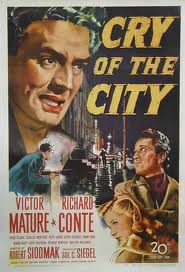
Years ago, a place called Atomic City sold MC the perfect t-shirt for Herr Cranky. On the front was a bare-chested man with the words “Victor Mature lives” written across his pecs and abs. The anguished dude’s thought bubble read: “I wish I was deep instead of just macho.” The Crankies were never quite sure why deep and macho were mutually exclusive, but ambiguity about Victor Mature’s character didn’t get in the way of their sartorial pleasure.

So now MC’s enjoyment of contemporary memoirs has left her feeling that her own character is about an inch deep. David Sedaris and Rhoda Janzen’s rip-roaring tales of substance abuse, emotional apocalypse,  and entertainingly wacko relatives didn’t encourage self-doubt. Anne Lamott’s essays, however, always leave MC scuffling her shoes in the dirt thinking, I could be a better person if I just meditated more. I should ask my neighbors to share their reflective personal insights. I should swim with seals more often.

Extra helpings of meditation could only improve MC’s operating system, true enough. But her neighbors are already sufficiently sage. And on the whole, she doesn’t see herself snorkeling with seals. Aquatic mammals can be plenty profound, but MC, sadly, is much too distracted to appreciate their offerings unless they come with English subtitles. Compared to Lamott’s thoughtful spirituality, MC is decidedly swimming in the shallow end.

People who make their living writing sensitively about single motherhood really should have zen-master-type moments in the middle of traffic. The rest of us, however, show our breeding and character by not bringing firearms to the pediatrician’s waiting room. Cranky 2 recently reactivated her strep throat, and MC repeated the familiar routine of doctor’s office, pharmacy, and frozen fruit bars. In a waiting room of children dripping with viruses and bacteria, the selection of pregnant-mommy magazines and Fox News broadcasts creates an atmosphere that the CIA could productively use to extract information from suspected terrorists. And yet the parental units of these little petri dishes purposefully douse themselves with hand sanitizer and exit with scripts for Amoxicillin. MC thinks that germ-encrusted politeness is perhaps the height of civil discourse.

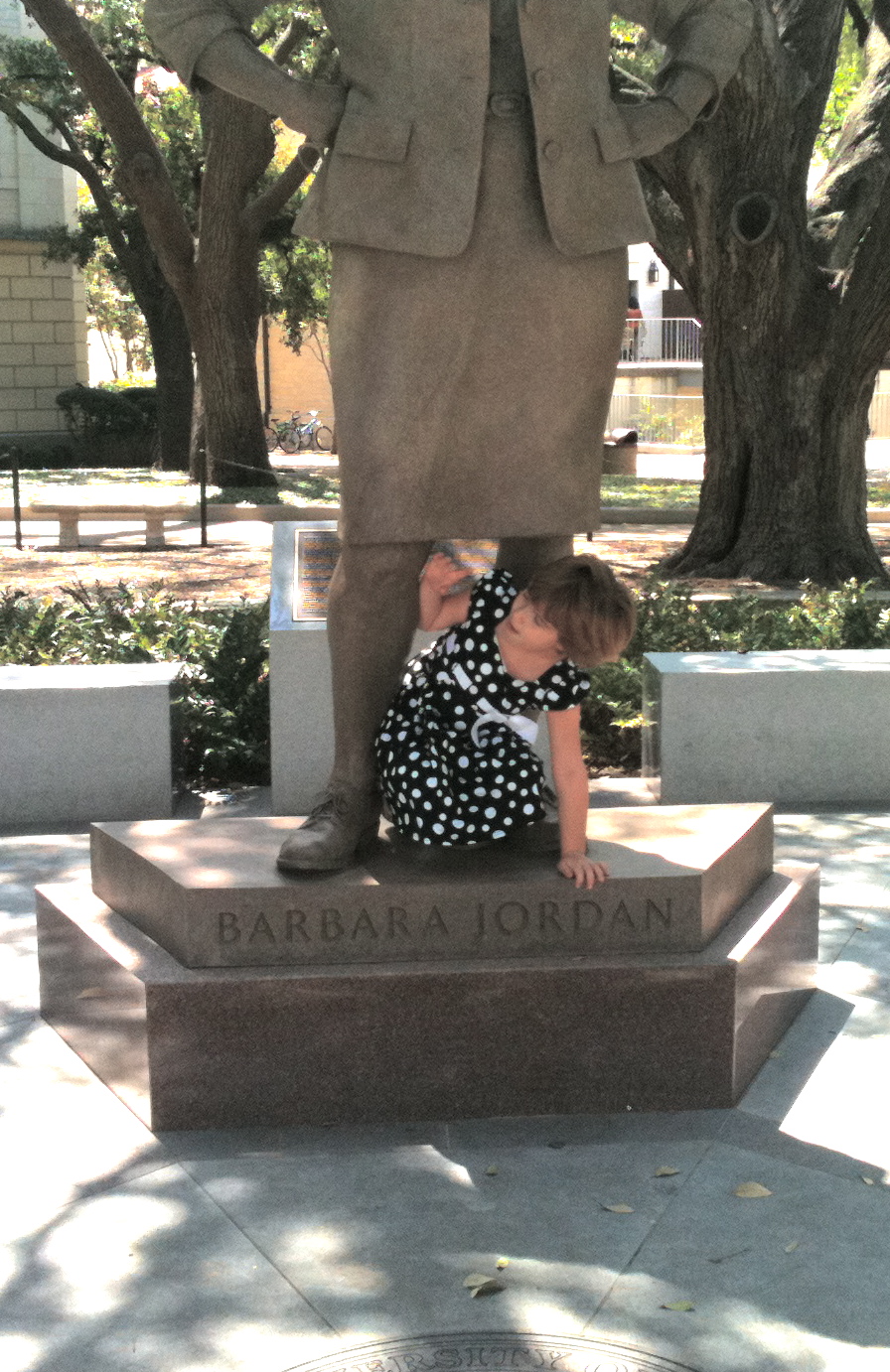
There’s a time and a place for depth of character. The Richard Nixon impeachment hearings, for example. And happily, Barbara Jordan knew just what to say:

My faith in the Constitution is whole, it is complete, it is total. I am not going to sit here and be an idle spectator to the diminution, the subversion, the destruction of the Constitution.

MC wishes she could manufacture pithy, quotable verbage like that on demand. Delivering stirring oratory is probably not in the cards for MC; however, a recently installed statue of Representative Jordan at Big State University invites one to reflect on depth of character, statesmanship, and why flawless enunciation and a baritone register sounds so, well, deep. C2 demonstrates what you can do after all that thoughtful reflection.
–MC