

February 16, 2021, 32nd and Speedway streets, Austin, Texas
A year into a global pandemic, I’ve developed an anger management problem.
It’s not my feral, uncut hair, or the strange substitutions that Randall’s makes in my grocery order. My god, half a million of my fellow citizens no longer have the luxury of caring about their hair and groceries.
It’s the weather, and when it becomes an “act of God.”
After Winter Storm Uri–we’re naming winter storms now?–I am constitutionally unable to speak rationally about power grids, the Texas Public Utility Commission, or Republicans who blame my 5-day power outage on wind turbines. During limited talk-to-other-people-time during Zoom calls or socially distanced pandemic chats, I lapse into rants that are the equivalent of TALKING IN ALL CAPS about my pure and sincere loathing of the Texas senator who flew to Cancun while our stoic Buff Orpington, Barred Rock, and Silver-Laced Wyandotte took refuge from freezing temps and laid eggs in our bathtub.
I’m from Oklahoma, so I know some weather. I’ve watched as the wind made a 20-foot barn door pitch like a ship at sea, sweeping my brother off his feet as he attempted to latch it down. I’ve hunkered in another brother’s storm cellar, heartily wishing I had picked up my baby’s diaper bag before dodging an inland hurricane. I’ve been frightened, humbled, and chastened by weather events, but incandescent rage hasn’t been my take-away, until now.
Being enraged by the events surrounding Texas’ winter storm is not the way I was raised up. My family was of the play-dominoes-until-the-water-goes-down school of crisis management. But a central family narrative was built around a cataclysmic weather event, an act of god that was a source of awe and drama, the perfect pairing of climactic and climatic. I didn’t experience this event, but I’ve always known how it moved the people caught up in it, because they took the trouble to tell me. Time and again, relatives and countrymen would recall where they were in 1957 when the salty brown waters of the Cimarron River rolled up fences, unmoored bridges, and made the people of my county stop while rain and heartbreak said their piece. The drought of the South Plains broke in the spring of that year, perfectly timed to amplify the loss of my impossibly handsome 36-year-old uncle, inexplicably dead of a heart attack, with the sky weeping tears for his family.

The front page headlines of my hometown paper on May 16 juxtaposed the two events that subsequently reshaped Western Oklahoma generally and my family specifically. Above the fold: “Savage Rain and Hail Storm Hits Hennessey; Heavy Damage Seen.” Below the fold, the headline reads “Kelly Hobbs Dies in Midland, Texas.” For the heartbreak to properly resonate, know this about Dean Kelly Hobbs: he was the heart’s darling of his family. This was a family with no shortage of material to work with: my father, thoughtful, handsome, responsible. A lovely younger sister who rewarded her brothers’ antics with an astoundingly enormous laugh. But Kelly was their beating, bleeding heart, the beautiful child and gorgeous man who delighted and endeared just by drawing breath.
Kelly died before I was born, but his lore persisted. I once spent an afternoon listening to a pal of Kelly’s named Beaman, who arrived unannounced at my mother’s table, then regaled me with stories about his friend, who by that time was 40 years dead. As an oil company landman in 1950s West Texas, Kelly would arrive in Midland regularly before weekends and file his paperwork with oil company secretaries. It was a mutually beneficial relationship. One Friday, he arrived with groceries at the house of a girlfriend, let himself in, and started supper. Several women shared this house, and they came home at the end of the workday. Multiple women entered the house, and apparently none of them were alarmed by the man in their kitchen. When the entire household was present, an awkward truth unfurled itself: the woman of Kelly’s acquaintance had moved to another house. By then dinner was ready, so they all sat down to eat.
Women made it their life’s ambition to marry my uncle. According to Beaman, Kelly’s boss watched a banker’s daughter focus on him with laser-like intensity. Addressing her persistence, the boss instructed Kelly to meet him in the oil company’s map room, where the glory of West Texas real estate was neatly marked with land owners’ names and pins for extant oil wells. Kelly’s boss pointed out the heiress’s extensive land holdings, and then observed, “I haven’t even shown you what her daddy owns.”
But like the hero of an F. Scott Fitzgerald novel, Kelly was not only charming and beautiful, he was also careless. In 1955, he married the executive secretary of a Denver oil man, and his life got complicated. He filed for divorce, but stress, and perhaps a blood clot from a minor car accident, left him dead on May 11, 1957.

The hometown weekly newspaper came out five days after Kelly’s death. The articles provide a timeline for the day’s events:
- 10 am funeral service at Methodist church
- 1:30 pm -3:30 pm–a 2.31 inch rainfall
- 3:30 pm-4:30 pm–rain stops
- 4:30 pm-8 pm–8.74 more inches of rain
The day unfolded thusly: after the Methodist funeral, family and friends drove to the town cemetery, where they brought my uncle home, shoulder-high, under cloudy skies. Before 1:30, many family members drove to the Hobbs ranch house, on the Cimarron River, with Kelly’s parents. I’ve never gotten a definitive headcount of visitors, but the small 4-bedroom house appears to have been packed. By the time they got there, it had begun to rain.

The crowd would have been crammed in the farmhouse from 1:30 to 3:30, during the first downpour. When the rain let up, some of the crowd said their goodbyes and headed back to town. The Briix cousins remember making it 3 miles, to the Firestone farm, where the road disappeared underwater. Teenaged Harvey Firestone was home alone and told them they couldn’t come in. The Briixes laughed and told him they couldn’t leave. Because by now had begun the Wagnerian deluge. The sky opened, and the rain farmers had awaited for seven years finally arrived.

As reported by the U.S. Geological Survey:
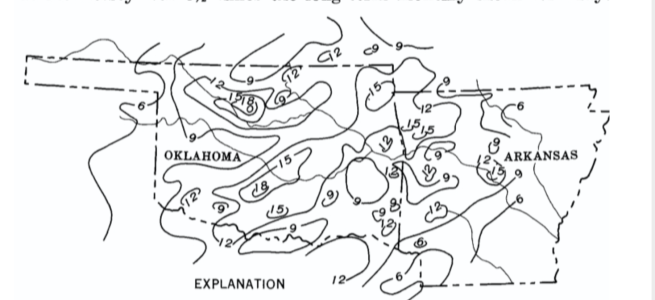
The storm of May 15-16 occurred over an extensive area in western and Central Oklahoma, generally north of the Cimarron River. The largest amount of precipitation reported at a Weather Bureau station was 13.07 inches at Hennessey. The maximum amount of precipitation found in a “bucket” survey for the storm was 20 inches, 5 miles southwest of Hennessey, and occurred in the 11 hour period from 7 p.m. to 6 a.m. Three miles northeast of this observation, 19.9 inches was measured in a large stock tank.
The site of the 20-inch “bucket” survey was approximately my grandparents’ north pasture, and anyone who hadn’t left already wasn’t going anywhere for days. Those who didn’t make it out in time included my parents, who had left their three boys back home with friends; my Aunt Barbara and her husband; Great Aunt Bobbie and blind Uncle Ralph; gorgeous cousin Carol with her new baby, Andrea, and most likely Carol’s parents; lovely cousin Margaret, with her second husband, Landrum; and apparently Beaman. I’m confident this list is incomplete–let’s say 15 people miserable people were stuck in a farmhouse with one bathroom. They retrieved all the canned food my granny had stored in her cellar. They used dishtowels as diapers for baby Andrea. People slept in the hay loft or in their cars. Uncle Ralph, whose blindness allowed him to distinguish some light from darkness, said “good morning” when awakened in his sedan’s back seat. He later confessed to have greeted a mule.
Relatives stayed in a damp, crowded farmhouse for most of a week. Yet the stories they told me were not about irritation, annoyance, or impatience. Instead, they marveled at their companionship, and they wondered at the sheer volume of water from a river more than a mile away, which turned the house into an island. Almost an island: water coming in the back door turned a north bedroom into lakefront property. Beaman described how Margaret’s new husband vigorously bailed water from the bedroom into the yard for a time. His industry was met by my grandfather’s mild observation: “Landrum, where do you think that water is going?”
The watery house, which had only recently acquired electricity and telephone service, maintained most of its limited infrastructure. The country telephone cooperative could connect to near neighbors, but not to the exchange in town. Consequently, my parents couldn’t report their predicament to the families at the county seat who were minding their three boys. Because of this communication snafu, my father’s cousins living all the way in California heard alarming news reports that my parents were missing, presumed dead. Because only dead parents would abandon their three children.
The rest of the county came looking for the family surrounded by the river. Soon, Carol’s husband, the banker, made arrangements with Irvin Bollenbach, the local crop duster; as the small plane flew over the house, Carol held up baby Andrea in the yard to confirm that she was, indeed, accounted for. When waters receded enough for the plane to land on the country road, my mother was the first person flown out. No one told me stories about how the rest of the family climbed back into their cars, or helped my granny put the house to rights, or chose their parting words. It had been a Methodist shiva, with family sitting five days, instead of seven.
In the flood of 1957, countrymen both rich and not-so-much were wet, inconvenienced, and poorer for the cost of new roofs for their houses and fences for their farms. But everyone in the county was humbled when a vast, brown river rolled across the sandhills. No one could entirely buy themselves out of this particular inconvenience: the banker’s baby wore dishcloth diapers, and her mother was grateful for them.
My current weather-related foul mood burns so brightly because the inconveniences of Winter Storm Uri were so unevenly distributed. The eat-the-poor stories just wrote themselves as lights burned in downtown highrises, while poor people froze to death in their cars. The tales of neighbors helping neighbors were of course heart-warming–I was particularly moved by the tale of a local musician who figured out how to fix tankless water heaters, repairing all the frozen units on his street, then posting a YouTube video for the rest of us. But the helpful neighbors only highlight the cold truth of this capitalist teachable moment: you better take care of your neighbors, because that’s all the help they’re going to get.
The 2021 winter storm that left me cold and inconvenienced for five days has also left me pissed off for the foreseeable future, since the state of Texas seems determined to shrug off its administrative and regulatory fuck-up. If enough Texans say, “hey that wasn’t so bad, but I’d better buy a backup generator,” then the problem of maintaining a power grid won’t much cut into energy companies’ profits. By contrast, I’m pretty sure that when the crop duster scooped up folks out of the Cimarron River floodwaters in 1957, the clever Bollenbach family wasn’t plotting to monetize an overpriced flood evacuation service.
The flood my family experienced was a force-majeure, an act of God that a state government couldn’t mitigate, other than by directing its citizenry to higher ground. In contrast, the five cold days of February 2021 were an act of capitalism, a deliberate choice to forgo meaningful energy regulation because it cost too much. The wet, grieving people in my grandparents’ house carried that event with them for the rest of their lives; it’s probable, then, that my sincere loathing of Governor Abbott’s incompetence–or indifference– will last a while longer.

 Cranky Girls farm
“Landrum, where do you think that water is going?” Your family never disappoints.
LikeLike