
In the perfect world I aspire to inhabit, forward-thinking parents welcome their darling infants into the world with more than just educational toys and organic crib bedding. In this fantasy world, parents would prepare their wee spawn for future success with a briefing book bringing infants up to date on what they missed prior to their lives on this planet. Kind of a “You Are Here” map for the family’s fun facts and emotional history. For example: We own a loveseat that would look at home in a New Orleans whorehouse; it came from great-grandmother Mimi and the re-upholstery wasn’t entirely successful. Or perhaps: There’s an empty green glass prescription bottle in the refrigerator with my grandfather’s name on it. I got it out of my mother’s refrigerator, and I don’t know why she put it there. When I’m dead, precious ones, it’s all yours. Or maybe: My father and his brother wrote regular letters home during their service in World War II, and their mother saved them in a duffle under the stairs. I never saw her unzip the bag, I imagine for fear of misplacing all that concentrated love and worry.
The most important intel in this imaginary book would be a robust section that, if studied, could replace years of therapy and various chemical palliatives. I’m imagining a kind of primer documenting parents’ joys and traumas, both the ones the parents acknowledge and the ones they’ve purposefully tamped down. Every computer program to come out of Silicon Wherever has a README file providing software installation guidelines, operating instructions, and troubleshooting suggestions. In this perfect world of my imagining, mothers and/or fathers would be bound by the laws of god and nature to provide children with a README file for their well-meaning but fucked-up parents.
In the real world we all live in, offspring effectively spend their lives compiling a virtual README of the unutterable joys and heartaches making up their parents’ internal software; the personal histories that formed the endearing quirks and less loveable eccentricities of their parental units. Even highly motivated children, however, recognize that they’ve started too late; the providers of egg and sperm led rich, quirky lives before they dreamed of baby-hosting, and baby is never going to know the half of it. It’s like trying to figure out the truth of the Rashomon mystery with only the bandit’s point of view, rather than also including the raped woman, the dead samurai, or that sketchy woodcutter.
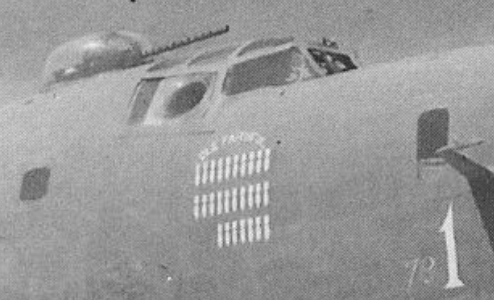
A lawyer in Fort Worth recently sent me a README file for my dad; she had gathered the materials to document the military service of her grandfather, an Army Air Corps pilot. My father seldom spoke of his wartime experience except to praise his favorite crew members, but his family knew damn well that he flew 50 missions out of North Africa in 1943 and was lucky to survive. We also knew that, after he finished his combat missions, he crashed his plane in Cornwall just before Christmas, and that half the people in the plane died. He didn’t talk about that crash until near the end of his life. He recounted to one of my brothers having one of those near-death experiences where you twirl down a beam of light and have a conversation with other-worldly beings. In his recounting, he landed at a table with professors he had met during his single year at the University of Oklahoma. When they asked him, “What are you doing here?”, he responded, “I finished my 50 missions.” My aunt recounted the element of the story known more generally in our family, recalled as a curiosity rather than a tragedy: when he awoke at a military hospital, our dad told the attending nurse, “You must be an angel.” He assumed he was dead.
The term PTSD hadn’t been invented when I was a child, but my family had a pretty good idea what it meant. Public-facing Dad adored good stories and rewarded them with a magnificent, whooping laugh. He tirelessly served on innumerable committees and boards in the small town he loved. When his favorite cafe waitress was sick in bed, he left bags of groceries at her doorstep. But private, family dad could be detached, emotionally distant, and sometimes inexplicably angry. He never removed the keys from his pickup, and when conversations turned awkward or uncomfortable, he had other business to take care of. Talking to our dad was unsatisfying, when, in his head, he was flying one of his 50 missions. One brother and I got a glimpse of the pre-pilot, pre-dad person we never met when, after his death, his favorite cousin described their regular phone calls. “I always said, ‘I love you, Charles,’ before I hung up, and he always said, ‘I love you, Winogene.’” My brother and I stared at each other, dumbfounded, before my brother walked outside to weep. When Winogene, equally dumbfounded, asked what had just happened, I told her, “Winogene, my dad would be buried and dug up again before he said ‘I love you’ to us.”

So a Fort Worth lawyer has gone to the trouble to not only construct her own README file, but, generously, to share it with me. Her grandfather was the co-pilot who didn’t die on that plane flying out of RAF St. Mawgan, a Consolidated B-24 Liberator which, because God has a sense of humor, was named “Ole Faithful.” I already had seen much of what she shared. An accident report describing engines that inexplicably failed. A weather report indicating light rain at 2:29 a.m. takeoff. A list of the dead high-ranking intelligence officers who were being ferried to a D-Day planning meeting. Seeing it gathered in one place, though, gave this intel a different impact. A plane that crashed a mile and a half from takeoff. Engines that revved too loudly and then suddenly stopped. And new to me were details about the Fort Worth lawyer’s recent trip to the Cornwall crash site.
One of the images that she shared struck me as particularly terrifying in its normalcy. It seemed inhuman that an Air Corps pilot who had finished 50 combat missions, had recently sent a V-Mail Christmas card to his mother, and had just observed his 24th birthday, would find heartbreak in a field so domestic and verdant. As part of her robust documentation, the Fort Worth lawyer photographed the field where Ole Faithful fell to earth at 2:32 am. It’s green and cute as hell, the epitome of what the John of Gaunt character meant by, “This blessed plot, this earth, this realm, this England,”

OK, so it wouldn’t have been green in December, but it still would have been sweet. If you’re trying to land a plane with only half its engines working and none of its flight instruments, the field’s flatness has a lot of appeal. Looking at this image, I was confident this particular pilot could still bring it home: He could land a plane without engines. I know this fact because my dad once described this experience as part of a stapled-together compilation for a Methodist Lenten study. His description recounts his last training school flight, when his instructor cut the plane’s engines somewhere over West Texas, told him to take the plane to xyz feet, and to hold it. Dad, about to fail flight school, reviewed the instrument panel. It told him: nothing for you here. Then a still small voice, like the one God used in his revelation to Elijah, told him, “There’s something you can do with your feet.” And damn. He could guide his plane with foot-operated flaps. Which he did. Just before he was about to fly into a farmer’s fence, the instructor turned the engines back on and said, “You pulled that one out of your hat.” Congratulations, you just won a free trip to Benghazi.
Landing a plane in a flat field, with no engines or instruments, at 2:32 am, might have been do-able. Buried in the newly shared intel, though, was the final impediment. Cornwall is famous for its hedges. Some of these intricate piles of rocks are 6,000 years old and date to the Bronze Age. Rich in wildlife and vital to erosion control, a picturesque Cornish hedge will shear the belly from a Consolidated B24 Liberator and leave it a pile of scrap metal.

If one were to go to a place once called Trewissick Farm in a village called Colan, one could apparently find pieces of Ole Faithful buried in a hedge, presumably still helping with erosion control and providing habitat for Cornish wildlife. I can provide directions, because a lawyer in Fort Worth gave me Google Earth coordinates.

So there’s my documentation. My fact-finding and troubleshooting, neatly organized by longitude and latitude. Add in a few more blurry War Department accident report photos and you’ve got a complete package. The next 50 years of guilt and grief don’t fit so easily into my README.
On Christmas morning in 1993, my new husband and I piled into a cold pickup truck to feed cattle with my father. Because he was fond of his son-in-law, my father always gave him his best material. So we were scarcely out of the driveway when he began with a cheerful observation: “Fifty years ago today, I woke up in a luxury hotel in England.” Do tell, we encouraged. “Of course, they were using it for a hospital then.” That’s all I remember of his story from that morning. On reflection I think, sweet Jesus, this was every Christmas to him.
My father’s favorite cousin, his childhood playmate with an infectious sense of humor, got the “I love you” telephone sign-off from my dad. The signature salutation I remember from him was, “Goodbye for now.” On reflection, the hope that he tucked into the “for now” is maybe all I should have needed. Sure, a conventionally adorable daddy would have come across with an “I love you,” just to meet expectations. The less conventional daddies, however, might be preoccupied with negotiating a safe landing.
README files are good for as far as they go; the real project fail, I think, happens when we put all our hopes and dreams into compiling the comprehensive record. One more factoid, one more data point, we think, and then we’ll understand those parents/children/significant others. Then we’ll know they love us.
For fuck’s sake. They’ve crashed into hedges at 135 miles an hour. They’re loving us the best they can.

 Cranky Girls farm